
 Completed
Strengthening the Protective Environment for Internally Displaced and Host Commu
Strengthening the Protective Environment for Internally Displaced and Host Commu
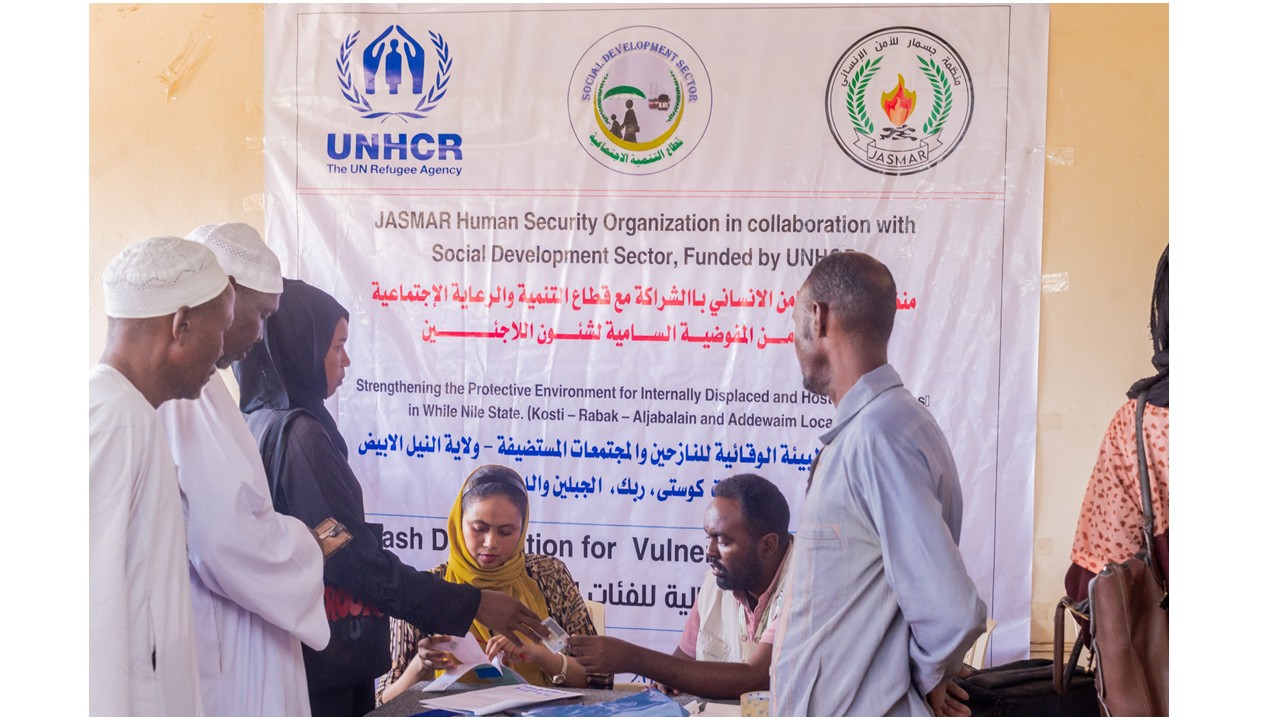
JASMAR Human Security Organization, in partnership with the United Nations High Commissioner for Refugees (UNHCR), implemented the Strengthening the Protective Environment for Internally Displaced and Host Communities in White Nile State project across Kosti, Rabak, Al-Jabalain, and Ad-Dueim localities. The project focused on strengthening community-based protection, improving access to protection assistance, building local capacity to identify risks and respond to needs, and promoting peaceful coexistence and livelihood opportunities.
Humanitarian Response
Conflict in Sudan increased protection needs among internally displaced persons (IDPs) and host communities in White Nile State, particularly in relation to protection services, mental health and psychosocial support, and access to essential services. People facing heightened vulnerabilities experienced challenges in accessing appropriate assistance, while the need for stronger community capacity to identify risks and refer people to specialized services became increasingly important. The project responded by strengthening local protection mechanisms and expanding support for vulnerable groups, while also promoting social cohesion and self-reliance.
Project Objectives
• Strengthen community capacity to monitor protection risks, identify needs, and support appropriate responses.
• Improve access to Individual Protection Assistance and mental health and psychosocial support for persons with specific needs.
• Build the capacity of community-based protection networks, volunteers, service providers, and community leaders.
• Strengthen GBV prevention and referrals to specialized services.
• Promote social cohesion and peaceful coexistence while exploring livelihood opportunities for IDPs and host communities.
Key Achievements
Protection Monitoring and Advocacy
• Protection monitoring: Reached 1,849 individuals, including 1,284 females and 565 males, to identify protection concerns and the priorities of displaced and host communities.
• Advocacy reporting: Produced four reports covering the situation of IDPs in 10 communities to highlight priority needs and inform humanitarian responses.
Capacity-Building and Community Protection
• CBPN training: Trained 90 members of six Community-Based Protection Networks in community protection, risk monitoring, referrals, case management, and psychosocial support.
• Volunteer protection monitoring training: Trained 40 community volunteers to identify and monitor protection risks and needs among IDPs and host communities.
• Referral pathway training: Trained 60 service providers, including 32 females and 28 males, in GBV identification, case management, referrals, and legal assistance.
• GBV prevention training: Trained 120 participants, including 66 females and 54 males, comprising CBPN members, religious and tribal leaders, and activists, in GBV prevention, case identification, and referrals.
• Psychological First Aid training: Trained 160 CBPN members and community volunteers, including 96 females and 64 males, in providing Psychological First Aid to people affected by crises.
• Code of conduct and protection standards training: Trained 120 CBPN members in dignity, accessibility, participation, safety, and minimum protection standards for service delivery.
Individual Protection Assistance and Psychosocial Support
• Identification of persons with specific needs: Identified and verified 1,572 people facing heightened vulnerabilities to inform appropriate protection assistance.
• Individual Protection Assistance: Provided one-time cash assistance of USD 135 per recipient to 705 persons with specific protection needs, including 450 females and 255 males, across Rabak, Kosti, and Al-Jabalain.
• Mental health and psychosocial support: Conducted 27 visits and 27 awareness sessions across 10 communities, identified 116 mental health cases, and referred them to a specialized centre in Kosti for further assessment and intervention.
• Multipurpose community centre rehabilitation: Rehabilitated and furnished four community centres to support protection activities and services for IDPs and host communities.
• Community centre equipment: Equipped the four centres with projectors, sound systems, and smart TVs to support training, meetings, and community activities.
Social Cohesion and Livelihoods
• Peaceful coexistence activities: Organized eight drama sessions and four sports events involving IDPs and host community members to promote communication, understanding, and peaceful coexistence.
• Income-generating group support: Selected 12 groups of five members each and provided the assets and materials needed to start businesses in grocery retail, clothing boutiques, and restaurants.
• CBPN operational support: Supported 150 members of 10 community-based protection networks across 10 communities to strengthen their ability to continue community protection activities.
Impact on Beneficiaries
The project strengthened community capacity to identify protection risks and respond to needs, while improving access to cash assistance and mental health and psychosocial support for people facing heightened vulnerabilities. Training for volunteers, community leaders, and service providers strengthened local knowledge of case identification and referral processes, contributing to a safer and more inclusive environment for displaced and host communities.
Joint community activities helped promote communication and peaceful coexistence between IDPs and host communities, while support for income-generating groups created opportunities to strengthen self-reliance and economic stability.
Enhancing Community Recilience (THABAT) Project
Providing life-saving emergency assistance through multi-sectoral response for t
Promoting Safe and Child-Friendly Learning Spaces for Psychosocial Support
JASMAR Human Security Organization in partnership with UNICEFThe project aimed to provide safe, inclusive, and child-friendly learning environments for children...
Interested in supporting this project?
Join JASMAR and help us work for human prosperity and dignity across Sudan.