
 Completed
Community-Based Protection for IDPs in White Nile State
Community-Based Protection for IDPs in White Nile State
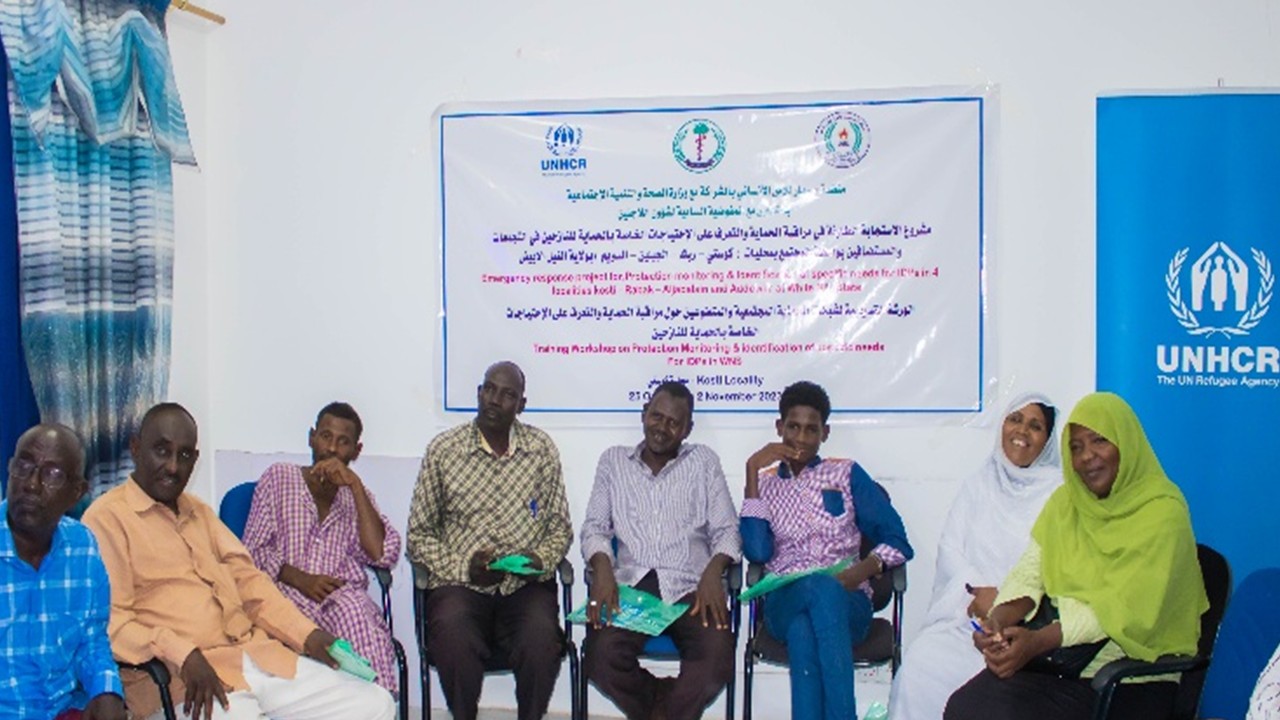
JASMAR Human Security Organization, in partnership with the United Nations High Commissioner for Refugees (UNHCR), implemented the Community-Based Protection for IDPs in White Nile State project, targeting internally displaced persons (IDPs) in Kosti, Rabak, Ad-Dueim, and Al-Jabalain localities.
The project focused on strengthening community-based protection mechanisms, improving the monitoring of protection risks and identification of urgent needs, and facilitating access to specialized services for persons with specific needs, including psychosocial support and Individual Protection Assistance (IPA).
Humanitarian Response and Context
The expansion of armed conflict in Sudan from April 2023 triggered large-scale internal displacement, making White Nile State a major destination for people fleeing Khartoum and other conflict-affected areas. Many displaced families stayed with host communities, while others settled in gathering sites, increasing pressure on local resources and essential services.
Displaced populations faced a range of protection risks and needs, including gender-based violence risks, family separation, mental health and psychosocial support needs, gaps in civil documentation and legal assistance, and the needs of persons with specific needs. In response, the project strengthened community-based protection monitoring, developed local protection networks, improved referrals to specialized services, and supported coordination between communities and humanitarian actors.
Project Objectives
• Strengthen community-based protection mechanisms and local capacity to monitor protection risks and identify urgent needs.
• Support people most affected by displacement, including persons with specific needs, through psychosocial support and referrals to specialized services.
• Establish community-based protection networks and strengthen the capacity of network members and volunteers to monitor and report protection concerns.
• Improve coordination and referral pathways among protection actors and relevant service providers.
• Document IDPs’ needs and priorities and produce advocacy reporting to inform the humanitarian response.
Key Achievements
Multipurpose Community Centres
• Selected, rehabilitated, maintained, and furnished four multipurpose community centres in Kosti, Rabak, Ad-Dueim, and Al-Jabalain localities to serve as operational bases for community-based protection activities.
• Used the centres to meet with Community-Based Protection Networks (CBPNs) and volunteers and support protection monitoring visits to IDP gathering sites and host communities, identifying protection risks, threats, and urgent needs for follow-up with UNHCR and other humanitarian actors.
Psychosocial Support and Case Management
• Provided psychosocial support services to 400 people most affected by displacement, including males and females from different age groups across the four target localities.
• Shared monitoring findings, urgent needs, and protection concerns with UNHCR’s Protection Section and relevant partners to support response planning and identify service gaps.
Community-Based Protection Networks and Capacity-Building
• Established 12 Community-Based Protection Networks (CBPNs), with three networks in each target locality and 15 members per network.
• Trained network members in protection monitoring and provided tools and stationery to facilitate their work.
• Engaged CBPN members and volunteers in supporting project teams to monitor protection needs and identify people with mental health concerns and persons with specific needs in IDP gathering sites.
Training for Volunteers and Stakeholders
• Trained 30 community volunteers in protection monitoring in Ad-Dueim and Rabak.
• Trained 15 stakeholders in referral pathways in Rabak.
Protection Monitoring and Identification of Persons with Specific Needs
• Conducted protection monitoring visits reaching 2,176 people in IDP gathering sites and among IDPs hosted by local communities.
• Identified 600 persons with specific needs and supported referrals to specialized services, including Cash-Based Interventions for Individual Protection Assistance (CBI/IPA) and Mental Health and Psychosocial Support (MHPSS).
• Identified and registered 175 persons with specific needs, of whom 159 received CBI/IPA.
• Shared other identified needs and service gaps with relevant partners to support coordinated follow-up and response.
Advocacy and Documentation
• Conducted protection monitoring from October to November 2023 in Kosti, Rabak, Al-Jabalain, and Ad-Dueim localities.
• Prepared and shared one advocacy report with UNHCR, highlighting the most pressing needs, concerns, and priorities of IDPs and providing recommendations to inform the humanitarian response.
Impact on Beneficiaries
The project strengthened community-based mechanisms for monitoring protection risks and identifying urgent needs among displaced populations across the target localities. Multipurpose community centres, protection networks, and community volunteers helped extend monitoring to IDP gathering sites and host communities and improve the identification of persons with specific needs and their referral to appropriate services.
Psychosocial support and referrals helped address the needs of people most affected by displacement, while protection monitoring and advocacy reporting provided information on IDPs’ priorities and concerns to support coordination and inform the humanitarian response in White Nile State.
Enhancing Community Recilience (THABAT) Project
Providing life-saving emergency assistance through multi-sectoral response for t
Promoting Safe and Child-Friendly Learning Spaces for Psychosocial Support
JASMAR Human Security Organization in partnership with UNICEFThe project aimed to provide safe, inclusive, and child-friendly learning environments for children...
Interested in supporting this project?
Join JASMAR and help us work for human prosperity and dignity across Sudan.